

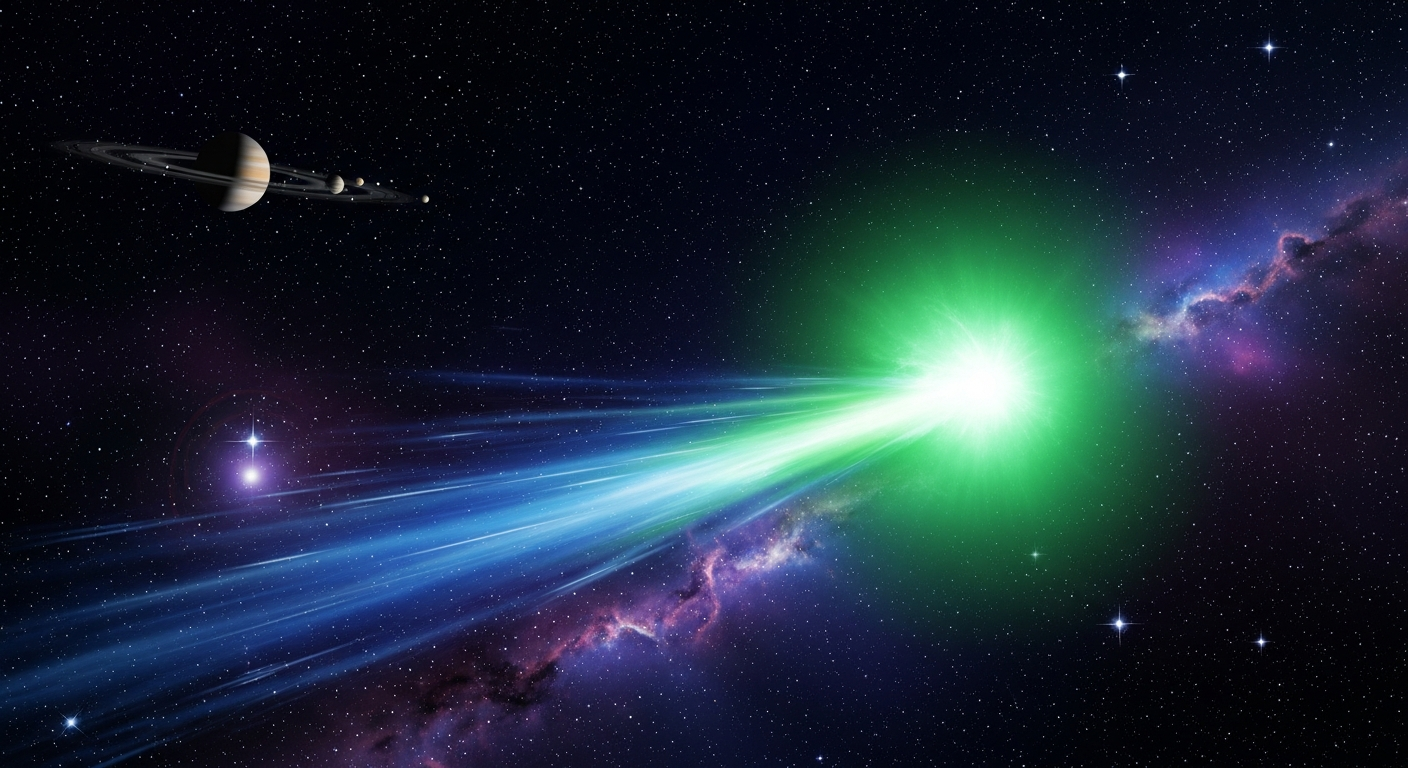
Imagine peering into the vast cosmic ocean, and witnessing a visitor from beyond our wildest dreams - a true interstellar traveler. In 2025, humanity will have a rare opportunity to observe just such an object: the interstellar comet 3I/ATLAS. This isn't just any comet; it's a unique messenger from another star system, offering scientists and stargazers alike an unprecedented chance to study matter originating from an entirely different corner of the galaxy. Get ready to embark on a journey of discovery as we explain everything you need to know about 3I/ATLAS, from its mysterious origins to the best ways to spot it in our night sky.
A Glimpse Beyond: Welcoming an Interstellar Stranger
For centuries, the comets we've observed have been residents of our own solar system, orbiting our Sun on predictable (or sometimes chaotic) paths. But in recent years, astronomers have confirmed a new class of celestial objects: interstellar visitors. These are wanderers from other star systems, ejected from their birthplaces and traversing the immense cosmic void for untold millennia before serendipitously encountering our Sun's gravitational embrace.
The discovery of the first confirmed interstellar object, 'Oumuamua, in 2017, sent ripples of excitement through the scientific community. Then came 2I/Borisov in 2019, the first interstellar comet, which offered tantalizing clues about planetary formation around other stars. Now, in 2025, 3I/ATLAS promises to deepen our understanding even further. Its impending passage is not just a astronomical event; it's a scientific goldmine, providing direct access to pristine material from another stellar neighborhood.
What Makes 3I/ATLAS So Special?
The Discovery of 3I/ATLAS
While the designation "3I" indicates it's the third confirmed interstellar object, its full name, 3I/ATLAS, points to its discovery by the Asteroid Terrestrial-impact Last Alert System (ATLAS) survey. ATLAS is a robotic astronomical survey system designed to detect near-Earth objects. Though its primary mission is planetary defense, its wide-field telescopes also happen to be excellent at catching unexpected cosmic guests. The initial observations of 3I/ATLAS quickly revealed its hyperbolic orbit, a tell-tale sign that it wasn't gravitationally bound to our Sun but was merely passing through, destined to continue its lonely voyage back into interstellar space.
Defining an Interstellar Comet: A Cosmic Nomad
A comet is essentially a "dirty snowball" - a cosmic chunk of ice, dust, and rock that, when warmed by a star, releases gases and dust, forming a luminous coma (atmosphere) and often a spectacular tail. What distinguishes interstellar comet 3I/ATLAS from its solar system counterparts is its origin and trajectory. Unlike typical comets that formed in the protoplanetary disk around our Sun, 3I/ATLAS formed around another star, billions of years ago. It was likely gravitationally ejected from its home system during a chaotic period of planet formation, much like some of our own Oort Cloud comets are thought to be.
Its hyperbolic orbit signifies that it has enough speed to escape the Sun's gravity once it swings by, meaning it will never return. This fleeting encounter is precisely what makes interstellar comet 3I/ATLAS so invaluable. It offers a pristine, uncontaminated sample of the raw materials from which another star system's planets were built, a cosmic time capsule arriving directly at our doorstep.
The Trajectory of a Traveler: Understanding 3I/ATLAS's Journey
Tracing its Path Through Our Solar System
Astronomers have been diligently tracking 3I/ATLAS since its discovery, refining its orbital parameters with each new observation. Its trajectory will bring it relatively close to the Sun (its perihelion) and then Earth, making it potentially observable with backyard telescopes and even binoculars, depending on its brightness. While precise dates and positions are continually updated, current projections indicate its closest approach to the Sun will occur sometime in early to mid-2025, followed by its closest approach to Earth in the months thereafter.
It's crucial to understand that comets are dynamic objects, and their brightness and tail development can be unpredictable. Factors like the outgassing rate, fragmentation, and dust production all influence its visual appearance. However, the scientific community is optimistic that 3I/ATLAS will provide a spectacular show and invaluable data.
Compositional Clues: What We Hope to Learn
The primary goal of studying interstellar comet 3I/ATLAS is to analyze its composition. By examining the gases and dust it expels, scientists can infer what conditions were like in its home star system. Are its elements and molecules similar to those found in our own solar system's comets, or does it harbor exotic compounds indicative of different stellar nurseries? This comparative analysis can shed light on the universality of planet formation processes across the galaxy.
Specifically, researchers will be looking for unique isotopic ratios, the presence of complex organic molecules, and the abundance of various ices (water, carbon monoxide, methane, etc.). These "fingerprints" will allow us to compare its composition to solar system objects and contribute to our understanding of the chemical diversity of star-forming regions.
NASA's Eye on the Sky: Observing 3I/ATLAS
Why is NASA Studying 3I/ATLAS?
NASA, along with other international space agencies and observatories, is keenly focused on 3I/ATLAS. The opportunity to study an object from outside our solar system is incredibly rare and scientifically profound. It provides a unique laboratory to test theories of star and planet formation, and to understand the distribution of elements and complex molecules throughout the Milky Way. Every bit of data gathered helps paint a clearer picture of our galactic neighborhood's history and evolution.
For example, if 3I/ATLAS shows signs of being heavily processed by radiation or cosmic rays over billions of years, it could tell us about its long journey through interstellar space. Conversely, if it appears relatively pristine, it might suggest a more recent ejection from its parent star or a particularly well-shielded existence.
Key Instruments and Observation Strategies
A global network of telescopes, both ground-based and space-based, will be employed for NASA 3I/ATLAS observations. Large ground observatories like the Keck Observatory, the Very Large Telescope (VLT), and the James Webb Space Telescope (JWST) will be crucial for spectroscopic analysis, allowing scientists to identify the chemical components of the comet's coma and tail. Radar observations might provide insights into its nucleus's size and shape, while specialized instruments will track its dust and gas production rates.
The combination of these instruments will provide a comprehensive dataset, covering everything from its bulk composition to its physical characteristics as it interacts with our Sun. This multi-faceted approach ensures that scientists maximize the scientific return from this fleeting visitor.
Your Guide to Spotting 3I/ATLAS in 2025
For amateur astronomers and casual stargazers, 2025 could offer an unforgettable celestial experience. While predicting the exact brightness of a comet is notoriously difficult, the general trajectory of interstellar comet 3I/ATLAS suggests it may become visible with modest equipment, and perhaps even to the naked eye under ideal conditions.
Best Times for Visibility
The best time to spot 3I/ATLAS will likely be in the months following its closest approach to the Sun in mid-2025. During this period, it will be at its most active, outgassing significantly, and potentially sporting a more prominent tail. Keep an eye on reputable astronomical news sources (like NASA's JPL Horizons, Sky & Telescope, or Astronomy Magazine) for precise ephemerides and updated visibility forecasts. These sources will provide charts and coordinates to help you pinpoint its location in the night sky as 2025 progresses.
Tools for Stargazers: From Naked Eye to Telescope
- Naked Eye: Under extremely dark skies, away from light pollution, and if the comet brightens considerably, you might be able to see 3I/ATLAS as a faint, fuzzy patch. Don't expect a dazzling display like some of the "Great Comets" of history, but a subtle beauty is still rewarding.
- Binoculars: A good pair of 7x50 or 10x50 binoculars will significantly enhance your chances of seeing 3I/ATLAS, revealing more detail in its coma and potentially a hint of its tail. These are often the best tool for comet observing, offering a wider field of view than telescopes.
- Telescope: For dedicated observers, a small to medium-sized backyard telescope will provide the best views, allowing you to observe the structure of its coma and potentially discern more detail in its tail. Wider field eyepieces are usually preferred for comets.
Finding Your Viewing Location
To maximize your chances of seeing 3I/ATLAS, seek out a location far from city lights. Light pollution significantly diminishes the visibility of faint celestial objects. A dark-sky site, a rural area, or even a high mountain pass will provide the best conditions. Allow your eyes at least 20-30 minutes to adapt to the dark before attempting to spot the comet. Use red-light flashlights to preserve your night vision.
The Scientific Significance of Interstellar Visitors
The study of objects like 3I/ATLAS is more than just academic curiosity. It represents a direct probe into the chemical diversity and physical processes occurring across the galaxy. Each interstellar visitor that graces our solar system provides a unique data point, helping us to answer fundamental questions about the formation and evolution of planetary systems, including our own. Are we unique, or is the universe teeming with planetary systems built from similar ingredients? 3I/ATLAS helps us piece together that cosmic puzzle.
Conclusion: A Once-in-a-Lifetime Cosmic Encounter
The arrival of interstellar comet 3I/ATLAS in 2025 is a truly extraordinary event. It's a chance to connect with a piece of the cosmos that has traveled untold distances from another star, offering a fleeting glimpse into the vastness and mystery of the universe. Whether you're an armchair astronomer or planning to head out with binoculars, prepare to be amazed. Keep an eye on the skies and the latest scientific updates, as NASA 3I/ATLAS observations unfold and reveal the secrets of this remarkable interstellar wanderer.